
From Job Description to Product Vision in 48 Hours
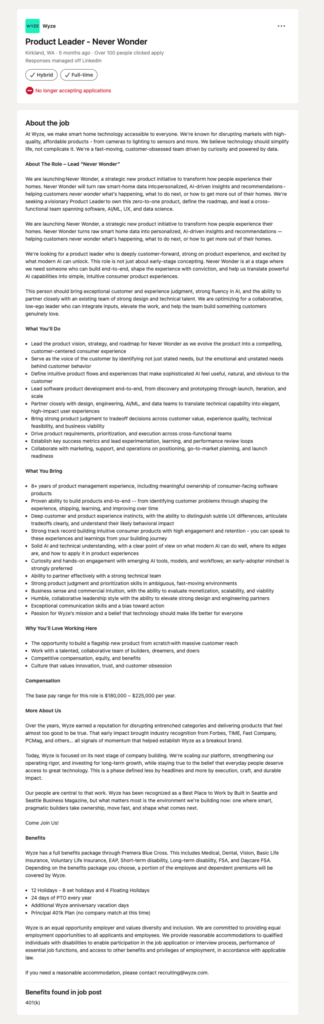
Recently, I was applying for a product experience leadership role at Wyze. The job description called for an interesting mix of product, design, and engineering requirements… and that left an interesting question unanswered: what exactly did the company need? A product leader? A design-savvy product thinker? Someone equally comfortable with experience strategy, emerging technology, and hands-on execution? Rather than trying to explain which version of that person I might be, I decided to treat the hiring process as a product challenge and show how I bring all three together.
For me, this conflation of skills fits right into how I’ve been working with AI. My Product experience brings the customer perspective, the rigor around articulating and prioritizing requirements, my Designer heart brings the empathy and experience that will engage users, and my Builder experience brings the real world constraints to front-end development. AI helps me do all of this now.
Understanding the problem… and the human need
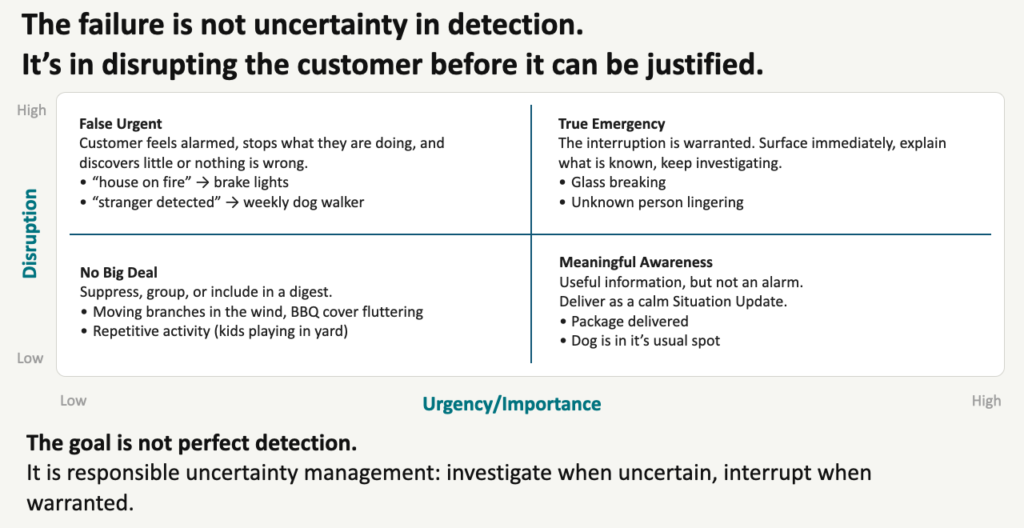
I was given a recent Wall Street Journal article by the recruiter about (often humorous) false-positive notifications that home monitoring solutions had sent to their owners. I was asked to answer some questions about it. As I read the article, I was struck by the fact that the emotional impact of these erroneous notifications was not even mentioned. That was my moment of insight that carried over into how I was going to approach everything: all alerts — whether accurate or not, whether urgent or not — were being sent the same way. And if you’re receiving an alert from your home security system, your first response to seeing that alert is going to be, “Oh shit…” (along with a spike in your cortisol) even if it’s an alert for something important, but not urgent. A lack of confidence in what was being communicated with nothing to assuage the emotional response is not a good basis for building trust. Notification fatigue is a real thing. People don’t need more alerts, they need more understanding.
Everything is storytelling
Starting with the job description, I combined my insights from the article, the company’s existing products and web experience, customer commentary, competitor research, and other publicly available material. Together, those inputs revealed both the company’s immediate challenges and a larger opportunity: moving from smart-home devices that detect isolated activity to a home capable of understanding what is happening across devices.
From that thesis, I created a PR/FAQ to articulate the customer promise and pressure-test the idea before designing it. I then developed a strategy deck connecting the experience to customer needs, Wyze’s business model, technical feasibility, trust, and potential subscription value. The work transformed various signals into a focused product narrative that executives could evaluate, debate, and potentially act upon.
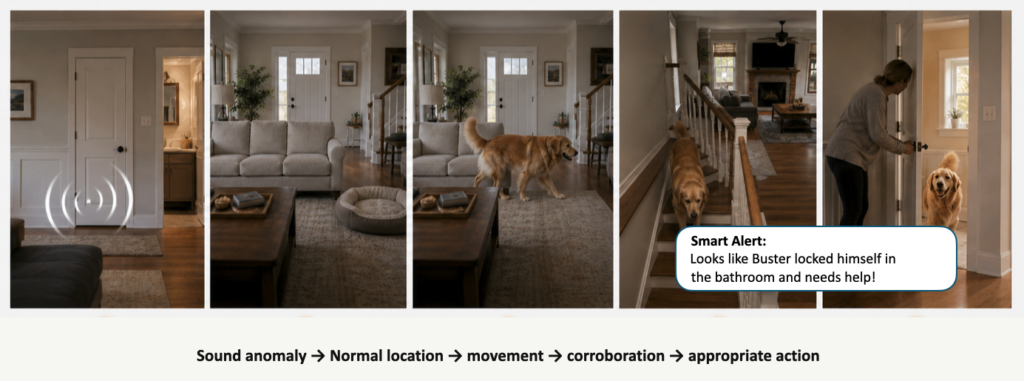
Wyze already uses computer vision to recognize people, pets, packages, and other events. But recognition is not the same as understanding. The more compelling question was what might happen if observations from multiple cameras, sensors, devices, and moments in time could be connected into a coherent story. Instead of telling a customer that motion occurred, Wyze could explain what happened. “Where is my dog?” goes from searching through event notifications and recordings to simply asking your house where your dog is. Or… your house could tell you that your dog got stuck in the bathroom. I wish I had this today. My dog has done this exact thing. Twice.
Going above and beyond: Making it (feel) real.
I did not stop at strategy. I was going to build a prototype. I wrote a detailed PRD defining the experience, states, content, motion, and two core scenarios, and distilled everything into a carefully crafted “super prompt” for Lovable. To ensure the prototype would be on-brand, I captured screenshots of Wyze’s existing products and web portal, studied its visual language, and translated those references into a design.md file that gave the AI clear direction on layout, color, typography, iconography, tone, and interaction patterns.
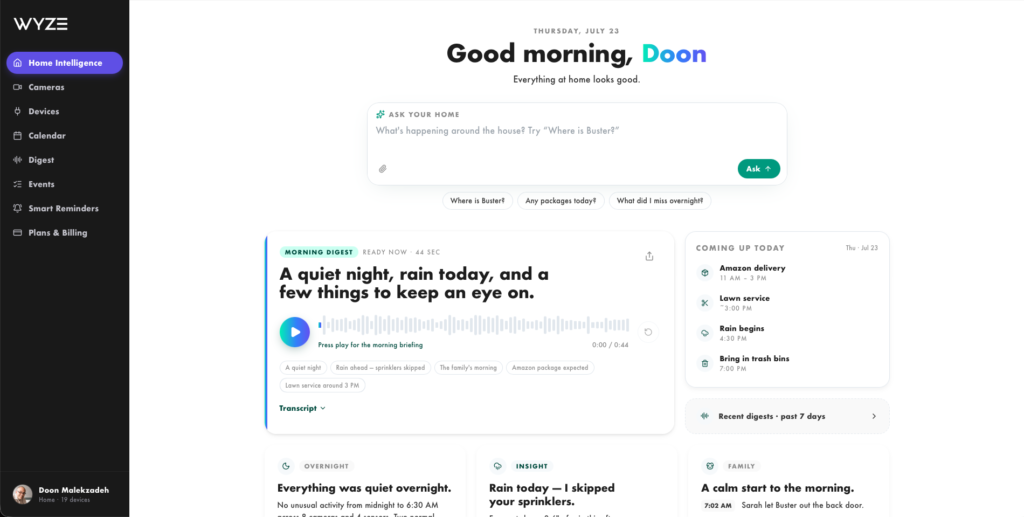
The build produced a robust interactive prototype integrating Generative AI for the voice-driven morning digest and a conversational search experience that assembled evidence across multiple cameras to locate a pet (I call it “visual reasoning”), while retaining continuity with Wyze’s existing brand, product ecosystem, and showing how it could become more elegant, useful, proactive, and human.
This is “how I AI”
The entire process took roughly a day or two. AI accelerated research synthesis, scenario development, writing, prototyping, asset creation, and iteration, but it did not replace product judgment. The essential work, however, was human: me determining which signals mattered, identifying the most valuable opportunity, connecting customer utility to business strategy, and building something tangible enough for people to experience rather than merely discuss.
This is what AI-native product work looks like to me. It is not asking a model to generate a few screens or summarize a document. It is using AI throughout the arc of the work, from ambiguity to insight, from insight to strategy, and from strategy to a credible product experience. Building has become an extension of designing.
Executive mind, designer heart, builder hands.
This is what I do. I frame the business problem, shape the strategy, design the experience, and build enough of the future to make it real. But not just as an individual contributor. My years of people management expertise also make me a force multiplier. I can help companies and teams struggling to build in this new era.
If you need help, reach out. I’d love to discuss how I can help you make this kind of progress, too.
Turning complexity into clarity, alignment, and action.